Saturday, September 18, 2010

Blog 2

This weekend, I watched the Notre Dame, Michigan State football game.  With the game tied and 4 minutes left, Michigan State punted the ball.  As Aaron Bates punted the ball in the air, I realized that what I learned this week in physics could be used to graph the flight of the ball.  If we were to use a position graph for beginning of the punt, we could tell both the velocity and angle of the balls flight.  Using these two numbers, we could find out the Vx and Vy through the formulas: Vx=Vcos(theta)  and Vy= Vsin(theta).  I also know that the entire time the ball is in flight, the Vx remains the same.  However, the Vy is continuously changing and when it reaches the ball's peak of travel, it is 0.  I had no idea that vectors and projectile motion played such a large role in the game of football and especially special teams.   This game was great and went all the way into overtime. 
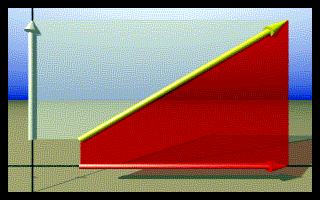
A Vector With Components Shadowed

Monday, September 6, 2010

Baseball and Physics

Even though I have played baseball for 12 years, I never understood how large of an impact physics had on the game.  As a catcher, there are many times when I need to catch a foul tip far behind the home plate.  When a batter hits a foul ball, the ball rises from his bat and is put into "free fall".  During this time, the only factor affecting the ball is gravity.  The ball has an acceleration of -9.8 m/ second^2 as it rises in the air (as well as a positive velocity).  When it reaches its peak of flight, the ball begins to move back towards earth at an acceleration of -9.8 m/second^2.  As it moves back towards the ground, the ball's velocity becomes negative.  This entire process may take no more than a few seconds.  This means that, as the catcher, I'm given little time to find the ball and move in to position under it before it hits the ground.  I now know that physics has much to deal with the game of baseball.